naturaleza · 9 min
Stargazing in El Tanque — astrotourism from the terrace
Northern Tenerife sits inside the largest Starlight Reserve in the Northern Hemisphere. We have a Sky-Watcher 90/900 telescope for guests, free of charge.
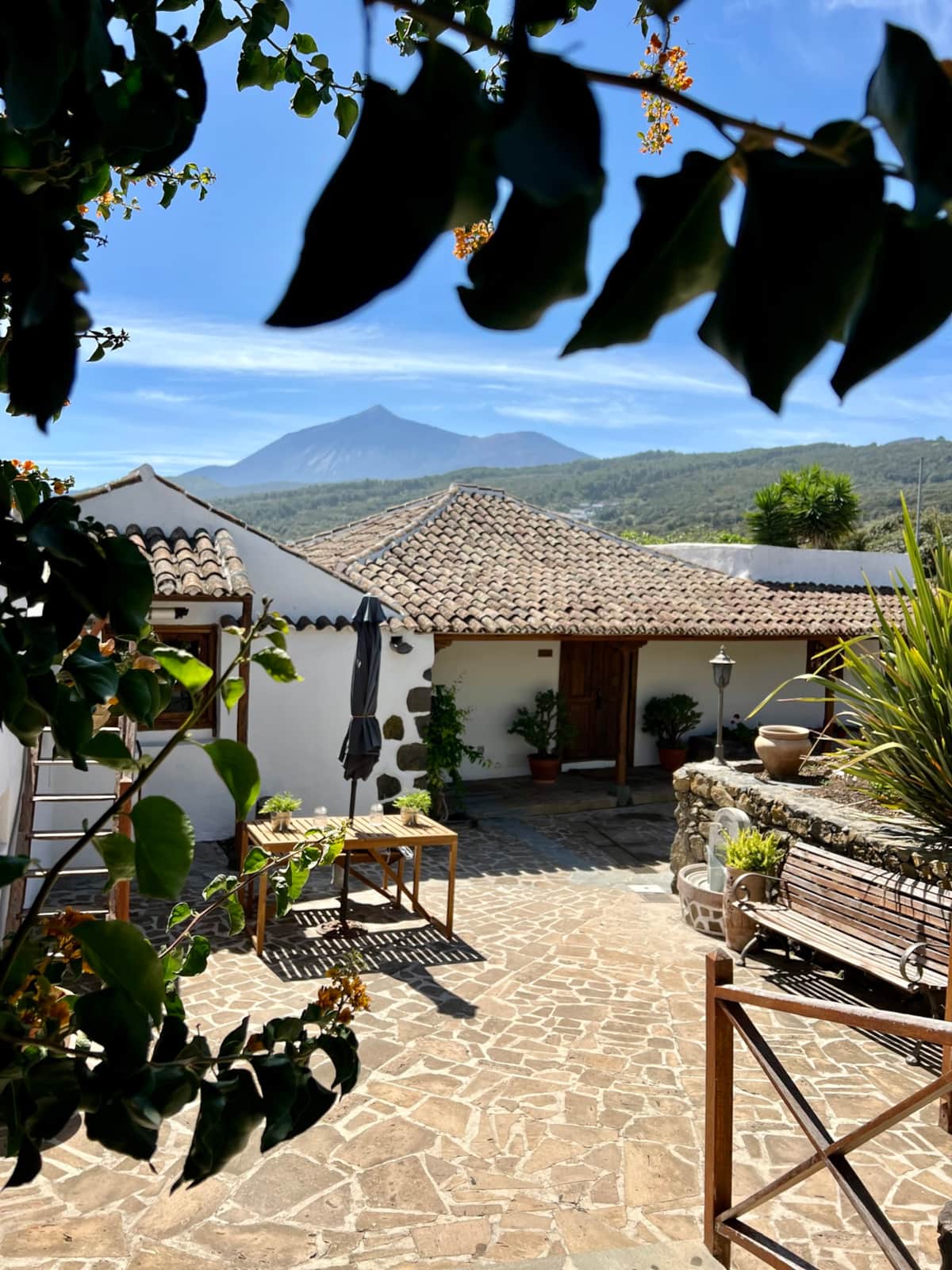
When a guest asks what there is to do in El Tanque at night, the most honest answer is: look up. Above you is one of the best-preserved night skies on the planet. And to see it, you don’t have to leave the terrace.
This guide is what we’d explain if you arrived on a Friday in October with binoculars in your backpack — what you can see, when, how, and why this exact corner of northern Tenerife appears on every astronomer’s map worldwide.
Why this sky is special
Tenerife doesn’t have a beautiful sky by accident. Three things combine:
- UNESCO Starlight Reserve. The certification covers Teide National Park and, by extension, the whole island. It’s the world standard certification for astrotourism, and Tenerife was among the first in the world to receive it (2014).
- The Canary Sky Law (1988) — the first law worldwide aimed at protecting astronomical observation. It regulates outdoor lighting across the island, radio emissions and night air traffic. That’s why street lamps here are amber, not white.
- The trade winds. The humid NE wind creates a sea of clouds at 1,000-1,500 m altitude, which acts as a layer absorbing light pollution from the south. Above it, atmospheric clarity is exceptional — the Teide Observatory is one of three most important professional astronomy centres in the Northern Hemisphere.
A number hard to picture: in a medium city (Santa Cruz, La Laguna) a trained eye sees 50-100 stars. In El Tanque, at new moon, the same eye sees over 1,000. The Milky Way isn’t suggested — it’s there.
What you’ll see from the terrace
If you have Casa Taoro or Casa Güimar, the terrace faces SE giving you Teide to the right and the horizon open all the way past Gran Canaria to the west. In practical terms:
- Milky Way: visible May to September, peak in July-August, crossing the sky from Cassiopeia to Sagittarius.
- Sagittarius and galactic centre: in summer, just above Teide at dusk. The densest arm of the Milky Way passes overhead.
- Andromeda (M31): naked-eye in autumn-winter, in the ENE. The farthest galaxy visible without a telescope — 2.5 million light years away.
- Pleiades (M45): cluster in Taurus, visible November to March, in the ENE in early evening.
- Winter constellations: Orion, Taurus, Gemini, Cassiopeia, Ursa Major — all in ideal position 8 pm to 1 am from November.
- Planetary conjunctions: Jupiter, Saturn and Venus are routine. The free Stellarium app (mobile or web) tells you what’s up each night.
When to go outside
| Plan | Best time |
|---|---|
| Summer Milky Way | July-Aug, new moon, 10 pm |
| Winter Milky Way (fainter) | October, new moon, 11 pm |
| Perseids (meteor shower) | 10-13 Aug, after 2 am |
| Geminids (best meteor shower of the year) | 13-14 Dec, all night |
| Eclipses | Public calendar at iac.es |
| Saturn with binoculars | May-Oct, southern sky |
Simple rule: check the lunar calendar. Three days before and three after full moon, the sky drops by half. New moon ±3 days = full sky available.
Our telescope (available for guests)
We have a Sky-Watcher 90/900 EQ2 at La Paredita, loaned free to anyone who asks. It’s an achromatic refractor with:
- Aperture 90 mm (lens diameter — more aperture = more light)
- Focal length 900 mm, f/10
- German equatorial mount EQ2 with optional tracking motor
- 25 mm eyepiece (36×) and 10 mm (90×) plus 2× Barlow up to 180×
What you actually see with this telescope:
- Moon: craters and seas in surgical detail. First thing we set up when someone has never looked through a telescope. Reaction is always the same.
- Saturn: rings perfectly visible. With the 10 mm eyepiece you can spot the Cassini Division on good nights.
- Jupiter: the four Galilean moons lined up as dots and the two main atmospheric bands.
- Mars: at opposition (every 2 years), polar cap visible.
- Venus: phases (like a tiny moon), very bright.
- Andromeda: an extended smudge (not as in photos — no amateur telescope shows it that way, those are long exposures).
- Clusters: Pleiades, Praesepe, double cluster in Perseus — spectacular.
- Orion Nebula (M42): in winter, with detail.
What you DO NOT see (so expectations stay realistic):
- Distant galaxies with defined shape (they look like grey smudges).
- Colour in nebulae (the human eye can’t process colour at low luminosity — physics, not the telescope).
- Exoplanets or small planet surfaces.
For all that, you need a professional telescope — and tour operators in Teide Park have them, 50 minutes away.
If you’ll use it: let us know in advance so we have clean eyepieces and the mount aligned. If you’ve never used one, we’ll spend 20 minutes on polar alignment and finding Jupiter or Saturn. Then you’re on your own and return it the next morning.
Minimum kit (fits in carry-on)
- Blanket or sleeping bag. The terrace is at 760 m, night temperatures drop 10-12 degrees vs midday even in August.
- Red torch. Your phone’s white light kills your night vision for 20 minutes. A red-filter torch (or red-mode on your phone) keeps it. We have them in the house — ask on arrival.
- 10×50 or 7×50 binoculars. If you’ll buy one thing only: binoculars before a telescope. More versatile, more stable, and enough for Jupiter’s moons, open clusters and Andromeda as a smudge.
- Stellarium (free, mobile/web). Point at the sky and it names what you’re seeing.
Three plans by ambition
Plan 1 — Terrace at home + loaned telescope
The realistic one, what 90 % of guests do. Early dinner, house lights off at 10 pm, sleeping bag, the Sky-Watcher we lend you (with instructions), binoculars if you have them, Stellarium. No car, no tour, no prior experience needed. On Perseid nights (August) you’ll catch 30-50 falling stars in an hour — just by lying there.
Plan 2 — Chinyero viewpoint (10 min drive)
Going down towards Santiago del Teide is the Chinyero volcano, Tenerife’s last eruption (1909). The viewpoint sits at 1,300 m, no trees or lights, southern horizon fully open. For summer Milky Way it’s dramatically better than the terrace — you literally see the galactic centre low with nothing in the way.
Plan 3 — Teide National Park (50 min drive, with tour)
To see everything at 2,200 m altitude, with a professional telescope and an astrophysicist explaining. Starlight-certified operators run trips almost every night except full moon, from Puerto de la Cruz or La Laguna. Typical price: 60-90 € per person, 3-4 hours. We give you verified contacts on arrival.
The free part
Sitting on the terrace with a hot tea, no signal, no notifications, looking up at a sky 90 % of humanity can no longer see. That’s the strange thing about this place. Not an experience that’s sold — one that’s chosen. That’s why La Paredita is here and not in the south.
If you stay three nights, one of them you’ll go out at 11 pm, wait ten minutes for your eyes to adapt — and you’ll understand why humanity spent millennia telling stories to the stars. Still works.
Coming to try it? Book one of our houses directly with us — Casa Taoro and Casa Güimar have the best terraces for sky-watching, but all four work.
Photo essay
Galería visual
Imágenes del entorno descritas en la guía. Para huéspedes que prefieren ver antes de leer.


Preguntas frecuentes
FAQ
Do I need a telescope to see stars in El Tanque?
No. The Milky Way is visible to the naked eye on any clear new-moon night. But if you want more detail, we have a Sky-Watcher 90/900 EQ2 telescope available for guests — free of charge, with basic instructions. Up to 1,000 stars visible naked-eye here vs 50-100 in a medium city.
Do you have a telescope at La Paredita?
Yes. We have a Sky-Watcher 90/900 EQ2 (achromatic refractor, 90 mm aperture, 900 mm focal length, German equatorial mount) loaned free to guests. Enough to see Saturn's rings, Jupiter's four Galilean moons, the Moon's craters in high definition, Andromeda and bright clusters. If you've never used a telescope, we'll teach you to align it and find the first targets.
Is Tenerife a good astrotourism destination?
One of the best in the world. The island has been a UNESCO Starlight Reserve since 2014, the Teide Observatory is one of the three major professional astronomy complexes in the Northern Hemisphere (alongside Hawaii and Chile), and sky quality benefits from the trade winds that clean the atmosphere.
When is the best time to see stars?
October to April, on moonless nights (±3 days from new moon). In summer there are the Perseids (10-13 August). Avoid three nights before and after full moon: your sky drops by half.
Is there light pollution in El Tanque?
Minimal. The village has low-consumption amber lights regulated by the 1988 Canary Sky Law — the first law in the world specifically designed to protect astronomical observation. Big difference vs Santa Cruz or La Laguna.
Casas relacionadas